 WhatsApp:+852-69577225
A Comprehensive Guide to the MOC3063 and Its Industrial Applications
12/30/2025 5:39:33 PM
Mastering Optocouplers: A Comprehensive Guide to the MOC3063 and Its Industrial Applications
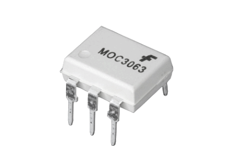
An optocoupler, also known as an optoisolator, is a sophisticated device that facilitates the conversion of electrical signals into optical signals and vice versa. This transition process involves three core components:
- An emitter
- A receiver
- A signal amplifier
When an input electrical signal is applied, it energizes a light-emitting diode (LED) to emit light. This light is then picked up by a photodetector. The photodetector generates a photocurrent corresponding to the light's intensity. This photocurrent is amplified to produce an output signal, thus achieving signal isolation.
Where does it shine? The primary advantage of an optocoupler lies in its one-way signal transmission, coupled with separate input and output circuits, providing exceptional electrical isolation and strong resistance to electromagnetic interference.
Types of Optocouplers
Optocouplers can be broadly classified into nonlinear and linear types:
- Nonlinear Optocouplers: Common models like the 4N series excel in switching binary signals but falter with analog signals due to their inherent nonlinear traits.
- Linear Optocouplers: The PC817A-C series, for example, demonstrates near-linear response behaviors, making them highly efficient for isolating control signals, especially small analog signals.
In power supply systems, linear optocouplers are generally preferred for their reliable signal processing capabilities. Misapplication of nonlinear optocouplers in scenarios needing linear responses can lead to poor oscillation waveforms or parasitic oscillations, destabilizing the system performance.
Overview of MOC3063 Optocoupler
The MOC3063 is an optocoupler integrating a gallium arsenide infrared LED and monolithic silicon detectors, serving as zero-voltage crossing bilateral triac drivers. This component finds frequent use in:
- Solid-state relays
- Solenoids
- Control valves
- AC motor drives
With a maximum input current of 50mA, it suits low-power applications. It efficiently operates up to 100°C and boasts a power dissipation capacity of 250mW. In zero-crossing circuits, its zero-voltage rating stands at 20V.
The MOC3063, housed in a dual in-line six-pin package, seamlessly integrates into various electronic circuits, offering both reliability and ease of use.
Pin Configuration: Functional Overview
- Pin 1: Anode
- Pin 2: Cathode
- Pin 3: Not Connected
- Pin 4: Main Terminal
- Pin 5: Not Connected
- Pin 6: Main Terminal
The LED's anode and cathode are identified as Pins 1 and 2, crucial for the optocoupler's operation. Pins 4 and 6, incorporating the TRIAC with zero-crossing detection circuitry, are significant for reducing electrical noise and ensuring signal clarity. Pins 3 and 5 remain unconnected, providing advantageous isolation in high-fidelity designs.
Frequently Asked Questions [FAQ]
1. What is MOC3063?
MOC3063 is a 6-pin zero-cross phototriac optocoupler that integrates a gallium arsenide (GaAs) infrared (IR) LED with a silicon detector.
This integration facilitates seamless interfacing between logic systems and 115/240VAC lines, ensuring robust isolation and reliable performance.
In practical applications:
- This component safeguards low-voltage circuits from potential high-voltage transients,
- A feature valuable for ensuring system integrity.
2. What is the driver IC MOC3063 used for?
The MOC3063 driver IC primarily provides AC isolation and is used to drive logic systems interfaced with 115/240VAC lines.
The zero-crossing feature minimizes electrical noise and reduces electromagnetic interference, contributing to the smoother operation of connected devices.
In diverse applications, including:
- Industrial motor controls
- Home automation systems
The MOC3063 proves to be invaluable for enhancing both safety and efficiency.
3. What is the operating temperature range of MOC3063?
The MOC3063 operates efficiently within a temperature range of -65°C to 150°C.
This extensive range ensures the device's reliability under varying environmental conditions, from extreme cold to high heat, making it suitable for various applications requiring robust performance.
For example, in geographical regions with significant temperature variations:
- Devices incorporating MOC3063 demonstrate enhanced durability and longevity.
4. What does driver IC mean?
A driver IC (Integrated Circuit) functions to control switching and display features in LCD and AMOLED panels.
These circuits must adapt to the growing requirements for higher resolution and faster data transmission, evolving alongside advancements in technology.
Driver ICs enable precise control over the display elements,
- Which is critical in achieving the high-definition visuals demanded in modern displays.
In practice:
- They contribute significantly to the user experience in consumer electronics,
- Ensuring crisp images
- Responsive interfaces
- payment



 Online